Saturday, February 5, 2011

Surviving the January Jones

I would like to encourage everyone to check out Steve Bird's new blog at columbiatrout. Not only is Steve a fantastic guide and a great friend, but he is leader in efforts to preserve the trophy rainbow trout population on the Upper Columbia River. As per Steve's instructions, I'm going to send an e-mail to Gary Douvia today. 
Scotty and I finally got over to the East side of the Cascades for some winter stillwater fishing.  As we descended into Cle Elum on a Saturday morning, we heard a grinding sound coming from the rear of my truck. I thought, "Dammit, the bearings on the trailer are locking up!" We stopped by the Shell Station on the way out of town. After about two hours of trying to locate the problem (The problem was not the trailer), we gave up and headed to Bridgeport, WA to fish Rufus Woods Reservoir. We tried to ignore the ugly grinding sound coming from my truck and focus on the fishing to come.
Well, we gave it the old college try at Rufus Woods stripping streamers all afternoon. Scotty picked up one small rainbow on his blue and white Barr Bou Face streamer. I spent the day trying to get a fish on one of my new booby flies. Naturally, I got skunked (but at least I got to mention my boobies).
The next day we decided to give Omak Lake a try. I've been hearing great things about Omak Lake lately, and although Lahontan Cutthroat fight like perch, I was excited to give it a try. The record cutthroat for this lake is 15lbs.
At Omak Lake, my nervous condition due to the sound of my truck was overcome by my anxiety about where to launch the boat. We saw lots of signs saying that this or that beach was closed to all but tribal members. Finally, we found a beach with no signs. By the time I could get the boat deep enough into the lake to launch, all four tires on my truck were in the drink. The day was cold but gorgeous.

We only saw two other people the whole day. Scotty landed two or three small cutthroat, and, naturally, I got skunked. Those cutties didn't fight much, but they splashed a little. Omak Lake is quite beautiful, and I can't wait to return for some sight fishing.
I dropped my truck off at the mechanics the following week. To make a long story short, I had to spend about $2,500 to have them replace the rear differential.

Monday, August 16, 2010

The B.C. Strike Indicator

The dry/dropper combination is one of the most effective ways to approach fish in shallow water or suspended just beneath the surface.  First of all, the dry fly tends to spook less fish than the bobber.   Sometimes fish prefer the dry, and the dropper can be eliminated.  At other times, fish key in on the dropper.
Fishing in British Columbia presents another challenge.  Anglers may only fish one fly per rod.  The dry/dropper rig is illegal.  I developed the yarn indicators below for fishing in British Columbia, but I believe that they will be quite effective on spring creeks, tailwaters, and desert lakes.  

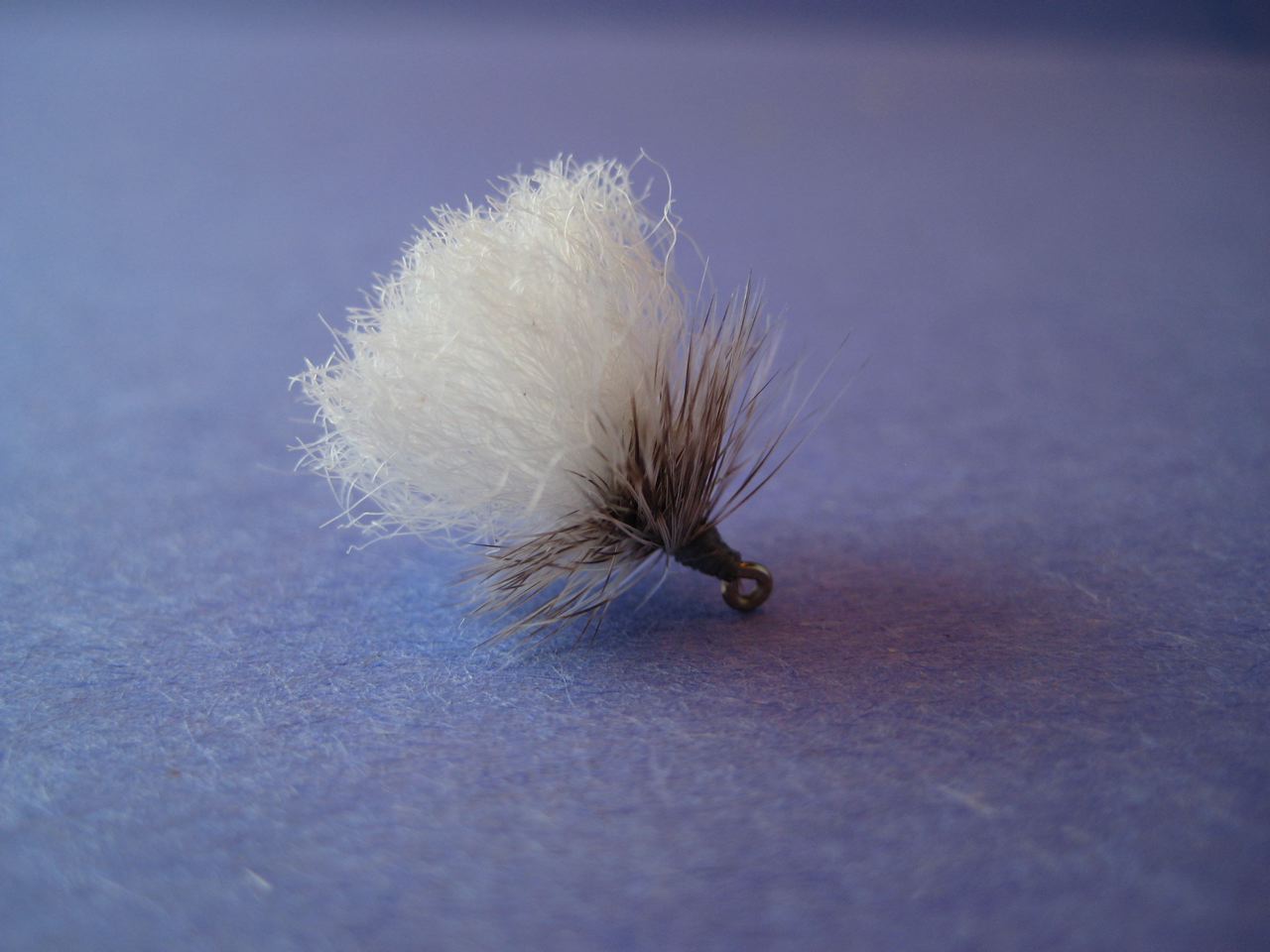
I am a big fan of parachute flies, so I designed this indicator to be a parachute fly without a body or a hook.  The best hook for this rig has light wire and a large eye.  To construct the indicator, secure a clump of yarn about 2 inches long and the diameter of a large pen to the front 1/3 of the hook shank.  Then double the yarn back so that both ends are secured parallel to the hook shank, sort of like a trude style fly.  Unlike the trude style fly, the yarn should extend along both sides of the hook.  Sometimes, I add dry fly hackle before I finish the indicator.  Sometimes, I just build a neat head at the hook eye. Next, I use a pair of wire pliers to cut off as much of the hook as possible.  The result is a parachute tied parallel, rather than perpendicular to the hook shank. I add super glue and/or head cement to the indicator following each step in the process. 

On a my recent trip in July to the Upper Columbia River in British Columbia, I found a pod of rainbows rising along a gentle seam.  The first couple of fish rose aggressively to an X-Caddis, but soon the others began to ignore my fly.  I picked us a few more fish on a CDC caddis.  However, there were several fish that would not eat my dry fly.  I tied one of my yarn indicators to the end of my leader and added another 24 inches of 4X leading to a size 16 soft hackle.   I made my first cast over a spot where a fish had been rising sporadically.  My little yarn indicator disappeared into the river and I set the hook into a beautiful 17 inch rainbow.


Saturday, August 7, 2010

Scotty's Birthday Bonanza

Last week I was fortunate enough to attend a carp and smallmouth fishing clinic.  The teacher was my good buddy, Scott, and he schooled me well.  On the two days following his birthday, Scott out fished me 5 to 0 on his own flies.  To think I knew Scotty when he was practically in diapers (9th grade).
Day 1:  Scotty wades out on a gravel flat looking for carp.  Scotty spots a fish. Scotty casts.  Scotty sets the hook.  Scotty tells me he has a small carp on the line.  Turns out to be a 5 lb. smallmouth.  Too bad the camera is in the boat.
Next, Scotty lands a 12 lb. carp.  Luck!
Finally, I get the camera from the boat in time to take a picture of Scott's next carp, a 15 pounder:
 I start asking Scotty where to fish, which flies to use, how to present the fly.  I start looking back at Scotty every few minutes in order to see if he's doing anything differently.  Is he standing in deeper water?  Is he stripping the fly more quickly or slowly?  What size hook is he using?  What color are the dumbbells on his fly? Finally, I snap off a large carp on a San Juan worm.   Scotty responds by hooking another big bass that jumps and throws the fly.
Surprisingly, Scotty is ready to go in for dinner by 4:30.  His arm is sore. 

Day 2:  Scotty lands a 3 lb. smallie on the second cast on a Barr's Bouface he tied over the winter. 
  
Should be a great day for me!  Not so much.
Next, Scotty lands a 3 1/4 lb. smallmouth on an olive Meat Whistle.
 I finally give in and start fishing with Scotty's flies, but it's too late.  The fish can smell my skunk from deep in the river.
At noon we give up and head back home.  I can't wait to get back out there to show those fish who's the boss!

Friday, August 6, 2010

My Lucky Bobber

Finding the right strike indicator has always been a challenge for me.  When I lived in Montana, I relied on my lucky bobber, a big orange corkie.

I'm sure I spooked a lot of fish with that bobber.  I remember presenting a tandem nymph rig, with my big lucky bobber, over fish rising to midges on the Madison River.  The bobber would instantly put the fish down.  It took a few trips that spring before I learned that rising fish don't respond well to big orange bobbers floating over their heads.  The midge hatch was fantastic that year starting in February.  Finally, in early May, I started using small dry flies, which led to some success. 

A few years later I started spending several weeks each summer fishing the Bow River in Alberta.  I noticed that individual fish would rise sporadically in some riffles and inside seams.  Upon seeing these random free rising fish, I would continue to cast my hopper/dropper rig or my tandem nymph rig with bobber.  I never had much luck catching these fish.  Finally, I learned to immediately change rigs upon seeing a fish rise.  I would nervously clip off my large hopper, add 3 feet of 4x, and then tie on a size 14 caddis pattern.  90% of the time those random risers would respond to my caddis emerger within the first three casts. Many of these fish turned out to be quite large, including a 23 inch brown I caught on an elk hair caddis just outside of Calgary.

Nowadays I use the Thingamabobber when fishing rivers.  It comes in many sizes and colors (including black, my favorite), and it floats and casts beautifully.

The quick-release strike indicators above work well for fishing chironomids and leeches in stillwaters.  These indicators can be purchased from  Phil Rowley's Fly Craft Angling Shop or Waters West in Port Angeles. With these lovely bobbers, you can fish a fly 25' or more below the indicator.  The only problem arises when they don't release properly.  Nevertheless, I carry a baggy full of them everywhere I fish.

Of course my favorite way to fish is naked, or with no strike indicator at all.  This method is particularly effective on stillwaters in water more than 10' deep.  You feel the strike just as often as you see it, and there is something very satisfying about fishing sans indicator.
In my next post, I will reveal my homemade yarn indicators.

Saturday, July 24, 2010

Love the Drake

When Steven Bird told me about the brown drake hatch on the Upper Columbia, I began researching the internet for useful patterns.  I found some Rene Harrop patterns that looked great, but I didn't have all the materials.  Consequently, I designed my own drake patterns using the materials I had.  The flies I tied are not unique.  Each is based on established fly patterns and fly tying concepts. By the way, Steven's unique and effective fly patterns can be found in his new book, Upper Columbia Flyfisher 

The fly below has its roots in the Parachute Adams and the Klinkhammer Emerger.  It also incorporates a trailing shuck much like a Quigley Cripple or Craig Matthew's Sparkle Dun.  I used ostrich herl for the body, poly yarn for the parachute, dun hackle for the wing, and ostrich herl and antron yarn for the tail.  I like to use black poly yarn for my parachute posts because black shows up so well in the evenings and on overcast days.  I also used black booby foam for the parachutes on some of these patterns.  The foam wing is unsinkable. 

White parachute posts show up better on bright days, and in my opinion, the fly below works as an attractor even when the hatch is not occurring.
Finally, although I rarely use them, I like to carry some flies with pink parachutes for those days when black or white wings aren't easy to see, or I just feel like casting my pink parachute fly. The flies above and below are tied with fine and dry dubbing for the body and peacock herl for the thorax.  The trailing shuck or tail is antron.
I have always had confidence in the Quigley Cripple.  The brown drake cripple below has a deer hair wing and a yellow foam wing case.  The rest of the fly is just hackle and ostrich herl (thorax, body, and tail).  Steven Bird and I discovered that we had each independently incorporated the yellow foam wing case.   I'm not sure if I discovered this idea independently or if I saw it somewhere in the past. 
Each of these flies works well for the hatch.  Fish seem more than willing to gobble them up recklessly.  Hooking the fish, however, is a separate challenge.  The key is to allow the fish to eat the fly.  The temptation is to snatch the fly out of the fish's mouth.

Thursday, July 22, 2010

How high's the water, papa?


Hiring a fishing guide is a big deal for me.  I don't have the budget for guided trips and I prefer to do it my way anyway.  Nevertheless, I decided to take advantage of a half-day guided trip for a very reasonable price through Steven Bird of Northport, Washington (Upper Columbia Flyfisher ). Steven has lived on the Upper Columbia since 1974.

Most folks hire guides in order to catch more fish, a worthy goal.  I've only been able to hire guides on a limited basis, but my goal is always to learn how to do it myself, whatever "it" is. I hired Steve in order to learn about the Upper Columbia River near the U.S. border with Canada.   Most importantly,  I wanted to know about the potential for fishing the Upper Columbia solo.  Do I have the boat that can handle 180,000 cfs?  Are the rumors true about this section's deadly currents? Etc...

When we arrived, Steve remarked that the river was as high as he had seen it, but the caddis hatch was just turning on, and he had landed 6 fish the night before on emergers.  I already was having my doubts.  I've never seen great fishing in high water, especially not great dry fly fishing.  Indeed, the fishing was not so great.  The hatches never seemed to materialize.  A few fish might rise here or there, but most activity was sporadic.  I hooked one fish the first night, and matters just seemed to deteriorate from there.  As Steve floated the river with us, he pointed out that most of the good fishing spots were so far under water that they were impossible to identify.


Finally, on our last night some fish started to rise more consistently.  I hooked and fought a 4 pound rainbow.  What a fish! It took a soft hackle emerger on the swing. I quickly got the fish on the reel, but it came straight at me so fast that I had to stop reeling and strip line as quickly as possible.  Next, the fish went under and around the boat several times.  Finally, I got it back on the reel only to have my 6 lb. tippet fail. Both Scott and I landed smaller fish later that evening. 

So, I fished the Columbia for about three days straight only to land one decent fish.  How would I rate the trip? On a scale of 1 to 10, I would give it a nine.  First, Steven Bird is a fantastic guy and a super guide.  Steven and his wife, Dorris, own a beautiful piece of property along the river where they can accommodate guests with cozy tents and home cooked meals.  The food was wonderful and the hospitality was unprecedented.

As for the fishing, what an experience!   Steven likes fishing spey rods and switch rods.  He recommended that we swing streamers or caddis emergers on our 8 weights.  Meanwhile, I'm a light tackle aficionado, and before this trip, I was not so interested in spey casting.  I know that swinging flies can be effective, but I always figure I can catch more fish on nymphs or dry flies.  I am glad that Steven approaches fishing so differently. Otherwise, I wouldn't have learned nearly as much!

It turns out that swinging wet flies is a superb tactic for this river because, although fish rise and rise often, they move around constantly.  Most of the good fishing on the Upper Columbia is in back eddies.  Multiple currents conflict with each other.  The river is so large that it breathes.  Thus, the water rises and drops several inches over and over again throughout the day.  A dead drift dry fly presentation can be quite challenging.  The wet fly swing allows one to present a fly to more fish more effectively.  The fish often feed in the top foot of the water column on the Upper Columbia, thankfully, because the back eddies are far too deep to present a nymph along the bottom.  Consequently, Steven has found that he has more success with unweighted flies fished with a 12 foot leader dressed with Xink.  The Xink causes the leader to break the surface, and the wet fly swings just under the surface.

Steven just published Upper Columbia Flyfisher, a wonderful book with great stories, unique fly patterns, and good information about the river.  I recommend Steven as a guide and I recommend his book for anyone who loves fishing, the outdoors, and literature. 

Monday, April 19, 2010

Columbia River Satisfaction


Sunday, April 18, 2010. Isn't it wonderful when a plan comes together. Yesterday was one of those days. For the last year, my primary objective for fishing has been to outfit a boat that is suitable for the Columbia River. I bought the boat in December, re-painted it despite the blustery winter weather, built platforms/floorboards, glued on carpet, added a double anchor system, and bought a new trailer. I must mention that my buddies, Scott and Mark, helped me at each step along the way.
Scott and I launched the boat just after 9 a.m. The sun was out, the wind was calm, and the temperature would eventually rise to almost 75 degrees. We motored up the river to a protected bay where I thought some smallmouth might be staging for the spawn. I was stripping an olive Barr's Slumpbuster in about 3 to 5 feet of water when I felt a tug. Probably a rock I thought. On the next two casts, I felt that same tug in that same spot. Hmmm. Must be a rock. This time I cast back to the spot where I felt the tug and stripped the fly back faster. My fly stopped as if hung on a rock, and the 4.5 lb. smallmouth pictured began its fight. A few minutes later the fish was in the boat, weighed, photographed, and released. What a way to start the season!

An hour later we were casting to schooling carp back in the same bay. First, Scott hooked a 15lb. carp that he fought for about 20 minutes until his tippet gave way. Later, he landed a 13 pounder on an olive Meatwhistle. The water was still around 50 to 53 degrees, so I am not sure how much these fish were really feeding. Nevertheless, they fought quite well.
This Columbia River fishery is fantastic. Miles of rocky shoreline with world class smallmouth fishing. Carp from 10 to 40 pounds. Drop offs, flats, islands.
I've fished this reservoir over half a dozen times and yesterday was the first time I've seen another fisherman, a gentleman fly fishing for carp from a jon boat. On the water, we gave this guy plenty of room. Later, we met our competition at the boat ramp.
We spoke for about 15 minutes as he told me about several spots I will have to try in the future. Later that afternoon we got in the truck to head home when Scott noticed a note on the windshield. I assumed that someone was angry with us for parking in the wrong spot or some other violation. Instead, it was a note from Steve, the other angler. He left us his e-mail and invited us to meet up with him sometime this year to fish the river together. What a great day!

You are lost
in miles of land without people, without
one fear of being found, in the dash
of rabbits, soar of antelope, swirl
merge and clatter of streams.

"Driving Montana" by Richard Hugo